Does schema help traditional SEO? What about AI search? The benefits change for traditional search rankings and AI responses. Let’s examine both types of search in more detail to understand how schema may help.
Schema for Traditional SEO Rankings
For traditional SEO, the main benefit of schema is that it can enhance some search result rankings, like adding pricing information to product pages. There is little evidence that schema influences rankings. Google has said it is not a ranking factor. If the site is already ranking, however, adding schema to enhance the ranking can often help improve the click-through rate, resulting in more traffic coming to the website.
Schema is only a suggestion to Google and will not necessarily change search results. Google restricts which schema types can change how a page appears in search rankings. Many clients we work with that use valid and supported schema markup do not see any enhancements in their website’s search result listings.
Incorrect schema markup usage can lead to manual actions. Ensure your schema markup correctly represents the content on your page. The biggest issue is that some content is only shown in schema markup and is hidden from a regular user’s view. When that happens, it might look like you are trying to manipulate search robots into seeing something that normal visitors to your website would not see.
Schema for AI Search
It is currently unclear what schema types, if any, are supported by generative AI engines. Microsoft has confirmed it uses schema when training LLMs, but OpenAI, Perplexity, and Google have not said if schema improves their LLMs. A study from Ahrefs found that schema did not impact AI citations, however, other studies have found promising results.
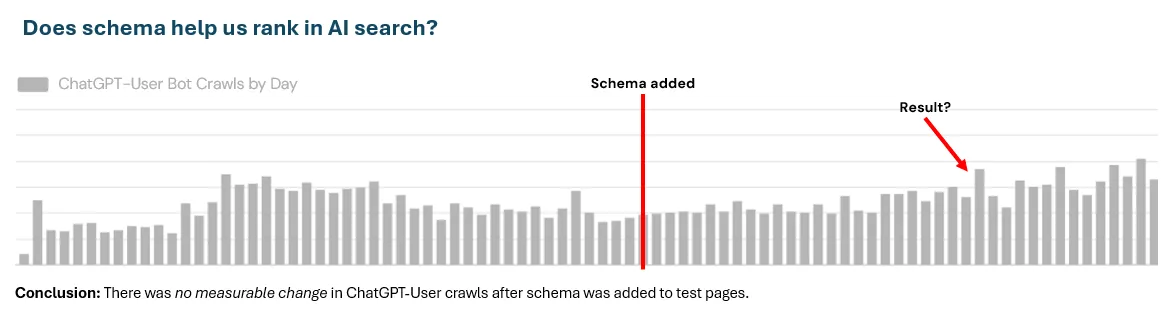
In testing this with various clients, we haven’t seen any notable changes in AI citations or bot crawl activity. Most of the schema tests we’ve run look something like the following chart, showing crawls from ChatGPT-User. There is little change in bot crawl activity after schema was added to this website. The same holds true when we’ve tested visits, mentions, sentiment, and traffic. There are a few jumps, which might indicate some kind of progress, but nothing significant.
We have seen some value in adding schema when there are rendering issues on the page. If a piece of key information is not included in the server-side HTML, including that information in schema code might make it accessible to AI bots. However, it doesn’t seem as reliable as addressing the deeper rendering issues facing the site.
All that said, I think it is worth testing schema on your website to see if it affects AI search results. We are continuing to test this with clients. As AI responses evolve and change, and as AI agents start using websites, it is possible schema may have a greater impact than it does today. That said, I would not prioritize schema above other tasks, such as improving rendering, crawl optimization, page discovery, or content optimization.
Measure Schema Impact
If you are testing schema, there are many different ways it could influence AI responses. Here are a few of the main ones to measure:
- AI mentions: Do your test pages appear more often in AI Overviews, ChatGPT, or Perplexity responses?
- Mention sentiment: Is your brand framed more positively or negatively?
- Traffic and visibility: Check for more direct or referral traffic tied to AI responses.
- Bot activity: Do you see an increase in visits from ChatGPT-User, GPTBot, or other LLM crawlers after schema is added?
- Agent activity: Can AI agents more successfully complete a task or find information on your website?
Need Help?
Do you need help measuring and evaluating how schema is helping traditional and AI search performance? Do you need help experimenting with schema? These are the types of projects we’re currently helping clients with at Elementive. Contact me, and let’s talk more about how schema could support your SEO and GEO strategies.