One of the best ways to reduce your website’s load time is to reduce the number of requested files. That includes fonts, CSS, JavaScript, and media files.
The median mobile web page as of February 2026 requests 70 files with a total request size of 2.6MB. Some sites are far above that. About 75% of websites load 5.9MB of resources or less, and 90% of sites are under 12.4MB.
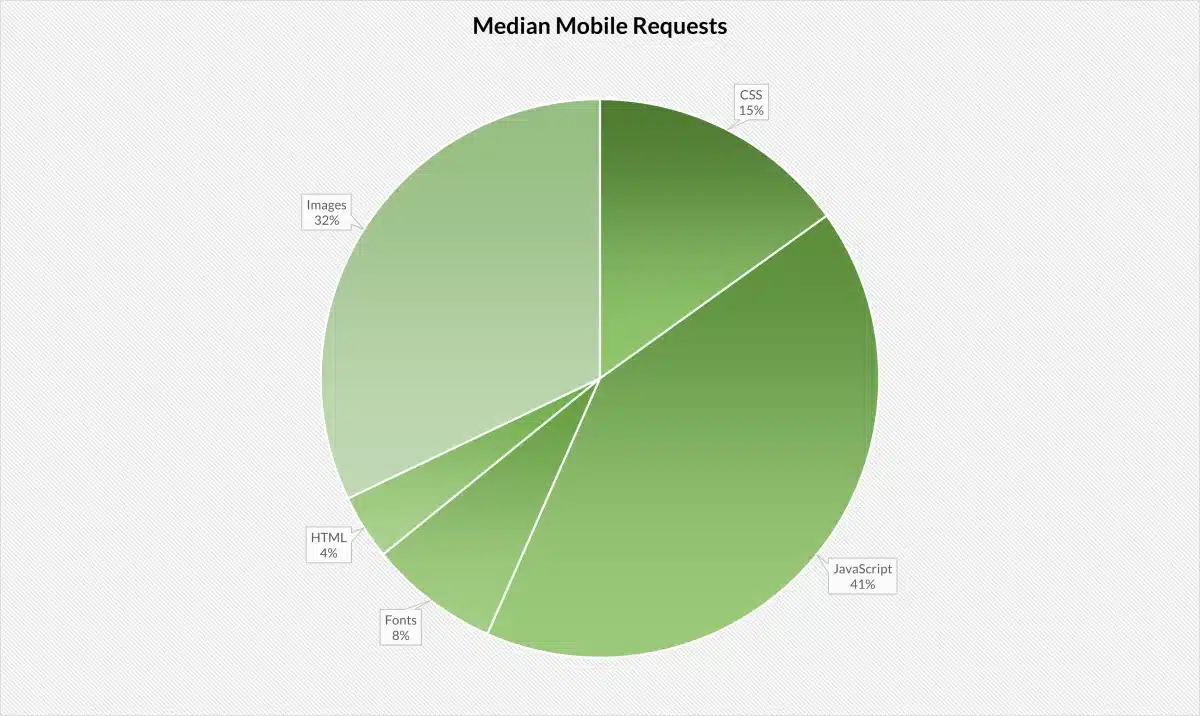
Why are websites so large? Most of the size comes from heavier files, including a median of:
- 22 JavaScript files totaling about 700KB
- 17 images totaling about 899KB
- 4 font files totaling about 156KB
- 8 CSS files totaling about 81KB
(All numbers from HTTPArchive, February 2026.)
There are two things to consider here.
First, we can (and should) make all resource files load as efficiently as possible. Modern browsers help us out by optimizing how requests are handled. Many users are on increasingly faster website connections (at least in some regions).
Second, and more controversially, just because we can try to make the files load more efficiently doesn’t mean we should.
Load time increases as more files are requested. When a bot, agent or human requests multiple files, each file generates a separate HTTP request. This adds to latency and processing time as the browser sends the request, receives the response, processes the file, and updates the page.
That means we need to intentionally consider each resource file we include on our sites:
- Do you need each tracking pixel on the website?
- Do you need every feature added by all the JavaScript files?
- How much unused JavaScript is loading on the page?
- Are custom fonts really necessary?
- Is every image added to the page important?
In most websites I audit, the answer is that we don’t need all these files.
Removing resource files rarely harms user experience as much as people expect.
- Many tracking scripts are for analytics or ad platforms that are no longer actively used.
- A/B tests we’ve run over the years show custom fonts rarely improve brand perception, conversions, or engagement.
- Some images are essential (like product images), but many can be removed or moved to secondary pages/modals without affecting performance.
When resources are removed, what usually happens instead is:
- Pages load faster
- Interactions become less clunky
- Layout shifts decrease
- Bots, agents, and users navigate the site more easily
- Engagement and conversion rates increase
In most cases, traffic quantity and quality typically improve with fewer resources loaded to the page.
I’m not suggesting we switch to plain text websites with no CSS, images, or JavaScript. We need to use some resource files. However, the goal should be to load as few files as possible and then load whatever resources are necessary as efficiently as possible.