WordPress is the most popular CMS, but is it the best for SEO?
Currently, according to BuiltWith, WordPress is used by about 41% of websites overall and about 20% of the top 100,000 websites. That type of volume means it is very easy to find people who build and manage WordPress websites.
The biggest advantage of WordPress is that it gives you a lot of technical control. You can do just about anything you want with a WordPress website, provided you work with a good developer. That includes being able to simplify the code to improve speed, rendering, accessibility, and more.
Of course, with that much technical control, WordPress can get complicated. There are so many plugins you can install and you can quickly end up with a tangled mess.
Some clients we’ve worked with have shifted away from WordPress, especially to Webflow. Webflow is very easy to work with and give some nice features out of the box. The downside is they do not give you the same level of technical control that WordPress does. However, Webflow typically loads faster out of the box than a WordPress website. That is generally true of Shopify and Squarespace as well.
We’ve also seen some clients shifting towards AI website builders, like Lovable, Bolt, Base44, Emergent, or others (there are many others). These no-code options do let you build a website quickly, but many of these systems have rendering issues (they rely heavily on JavaScript) and need additional configuration to load correctly for bots.
What about SEO? One simple way to compare this is with data from HTTPArchive.
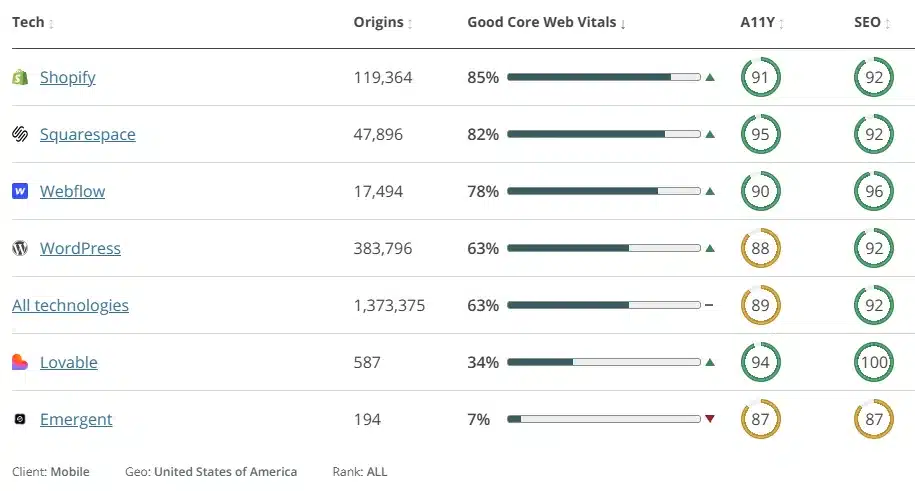
Out of the box, Shopify, Squarespace and Webflow all do pretty well with Core Web Vitals.
WordPress doesn’t as reliably pass Core Web Vitals. However, with nearly 400K websites in this sample, there is a big range. Plenty of websites built with WordPress score very well on Core Web Vitals provided some effort is put into the website build.
The AI builders, like Lovable and Emergent, tend not to do as well with Core Web Vitals. Obviously, this too will vary by site and depending on exact configuration.
Interestingly, though, all of these sites score pretty much the same on Lighthouse’s accessibility and SEO scores. I’ve worked with clients using all these systems and based on my own experience, all these systems have an equally good chance of ranking or earning citations.
So, what’s the best CMS for SEO? My take: Your CMS choice isn’t going to matter as much as your site structure and content quality. Pick whatever CMS you want. If you aren’t sure, go with WordPress. BUT whatever you choose, find a good team (including a good technical SEO consultant – hi!), who can help you build it correctly.